1.4
The economics of multiplexes
The previous sections surveyed the existing state of knowledge on the
multiplexes and their impact in the European exhibition sector. The empirical
evidence from the LE/BIPE survey has confirmed the importance of numerous
issues, such as the impact of screen density, discussed in Section 1. In
this section, we consider some strategic aspects of multiplex operations
from an economic point of view.
There are a number of features of demand for cinema which are important
in understanding the advantages associated with multi-screen cinemas. We
focus on three features, using economic models.
-
Films have a relatively short life: demand for a film is built during the
first days of release, and then declines rapidly through time. We see how
multiplexes capitalise on this feature using the Dynamic Demand model.
-
The level of demand itself is also unpredictable, so that cinema exhibition
is characterised by risk. Multiplexes help the exhibitor to deal with unpredictable
demand. We illustrate this in the Random Demand model.
-
Personal tastes and preference have a large influence of the demand for
films. Multiplexes enable a single exhibitor to show films of different
genres in one cinema. We investigate this aspect in the Dispersion
of Taste model.
The three models are treated independently of one another, so as to focus
on one issue at a time. All three models focus on the effect of having
many screens, in terms of capturing existing demand for films and cost
economies. The models do not go into the possibility that multiplexes generate
new demand, for example by providing free parking, or by giving customers
a second choice if their first choice film is sold out. The following sections
present each model, the dynamic demand model is discussed in greater detail
(see Model 1), while the other two models are summarised very briefly (see
Models 2 and 3).
Model 1: Dynamic Demand for Films
New films are released at different dates and at any one time there
will be many films shown in cinemas. A number of them will be in their
first week of release; others will be well through their release. Films
also differ by type: there are blockbusters, less popular mainstream films,
art-house films and repertory films. By having more than one screen on
the same site, the cinema can show more than one film at a time, thereby
attracting larger audiences. The other possibility is to build other cinemas,
but there are clearly economies of scale in building them on the same site:
these economies are exploited fully in a purpose-built multiplex where
the screens are set out so that a single projection room can serve all
the screens.
If a cinema with more than one screen is being built, or if an existing
single screen cinema is to be refurbished to include more screens, two
questions naturally arise: what is the optimum number of screens to build,
and how many people should each one hold?
In order to investigate these questions, we begin with a simple model
of demand and supply of exhibition of in a small town. An entrepreneur
is considering building one or more cinemas in a town where there are currently
none. The hopeful exhibitor has three main choices which we investigate
below using the Dynamic Demand model:
-
how many sites to build on;
-
how many screens there should be in each cinema; and
-
how many seats to have in each screen.
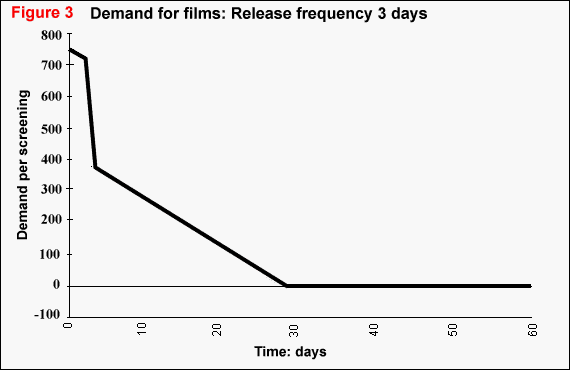
In this model, we assume that films are released at regular intervals,
and the frequency of release lies outside the control of the exhibitor.
The demand for each film is greatest when the film is released, and then
decreases as time passes. When each subsequent film is released, demand
for the first film drops suddenly, and then continues to fall at the original
rate. The first drop is greatest; the following releases have less effect.
A film's audience is usually built up during the first week of release,
either as a result of distributors' marketing strategy or because of audience
demand leading the supply. We concentrate on the audience of a single screen,
assuming that the film in question is neither arriving nor leaving a screen
nearby. Figure 3 presents the resulting shape of
the demand function for an individual film over time. The demand is the
average number of people who wish to attend a single screening of the film.
We assume that this pattern of demand is the same for all films(11).
The effect of release frequency on demand
We are interested in exploring the effect in the model of changing
the assumed time between releases. In order to do this, we must make some
assumptions about the effect that changing this parameter has on demand.
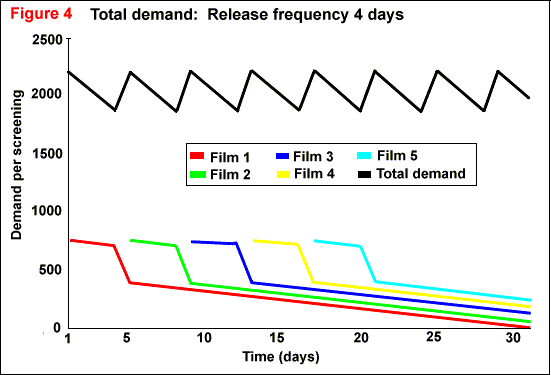
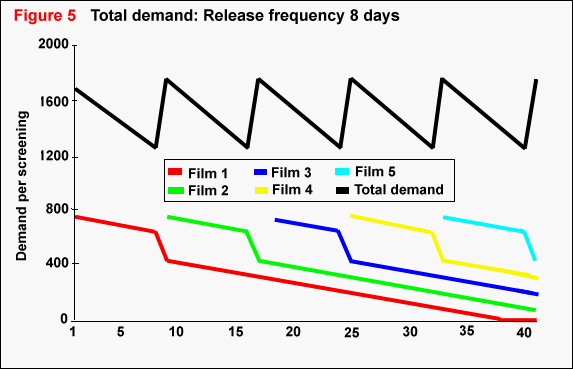
In our model, as release frequency increases, total demand at any time
will increase. In other words, we assume that demand is to some extent
driven by supply. However, this effect is not without limit: in the model,
as the frequency increases, the reduction in demand for a film when the
following films are released increases. Figures 4
and 5 show the demand for films, and total demand,
with four and eight days between releases respectively.
Increasing the frequency of releases also decreases the length of time
for which there is positive demand for any given film. If there are more
films coming out per unit time, then interest in each film is sustained
for a shorter period. Table 28 shows the duration
of demand for different values of T, the time between releases.
|
Table 28
Duration of demand for films
|
|
Time between releases (days)
|
Demand period for each film (days)
|
|
1
|
21
|
|
3
|
29
|
|
5
|
33
|
|
10
|
41
|
|
30
|
51
|
SOURCE: MEDIA Salles/London Economics
The cost of screens
We assume that there is a fixed cost of building screens, and that
the marginal cost of an extra seat falls in the capacity range we are interested
in.
There are economies of scale in building screens together on one site.
Less land is needed, and less staff. Staff can be saved in administration,
in selling confectionery, and in manning projectors, if the cinema is purpose-built
so that all screens are served by a single projection room. While we assume
that the costs per seat for any particular screen is the same, different
assumptions have been used regarding fixed costs per screen. In this way
we can analyze the effect on the number of screens built of the exhibitor
exploiting the economies of scales by building a multiplex on one site.
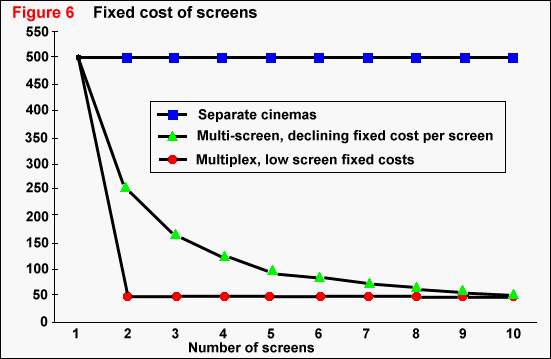
We do this by assuming a different pattern of fixed costs-per-screen
in three cases:
-
when screens are built on separate sites, fixed costs are constant across
all screens;
-
a multi-screen establishment would have costs exploiting traditional economies
of scale, so that the fixed costs of extra screens falls gradually; and
-
a purpose-built multiplex, which exploits all the potential advantages
of this type of establishments, such that the fixed costs of an extra screen
are substantially lower than the initial investment level, and constant.
These three patterns for fixed costs for additional screens are shown in
Figure 6.
By reducing the fixed cost element of the smaller screens, building
on one site makes more screens profitable, and so more screens are built.
This in turn means that overall attendance will be greater in the catchment
area: the extra small screens will cater for the "tail" of the demand curve,
those people who want to see the film towards the end of its release.
 Results of the model
So far, our model has established that as more films are released per
unit of time, the demand period associated with each film becomes shorter.
We have also established that additional capacity has different costs in
the three types of cinema analyzed.
Consider first the case of building only one screen. If extra capacity
came at no cost, the best choice would be to build a screen large enough
to hold the entire potential first night audience. The capacity utilisation
of the screen would then decrease as interest in the film fell away, until
a new film is released, attracting new demand. However, since there is
a cost to building extra capacity, there is a trade-off between being able
to accommodate the potential first night audience and the cost of empty
seats during the latter period of the release. At the optimum capacity,
the cinema will be full for a period at the beginning of the release, and
will then empty gradually.
Given the characteristics of demand, the model calculates the optimal
capacity for each screen, and the optimal number of screens. The latter
is determined by adding screens until the smallest screen is not profitable.
For example, if a sixth screen would not be profitable, the optimal number
is 5.
At optimal capacity level, with this number of screens, there are two
sources of excess demand: in the first period of release, because screen
sizes are below the level of demand at the time of each new release; and
in the tail of the demand curve, where it is not profitable to build a
screen of any size to accommodate so few customers.
We now consider the effect of varying the demand and supply parameters
of the model.
The effect of more frequent releases
Tables 29 and 30 show
the effect of varying the frequency of releases. As releases become more
frequent, more screens are built. This is because the "lifetime" (i.e.
days of positive demand) of each given film decreases as more films are
released in a period of time and demand is concentrated in the first days.
When there are 30 days between each new release (bottom row), only
one screen is built, with a capacity of 640 seats. Demand for the film
continues for a total of 51 days (see Table 28).
However, it is not profitable to build a second screen to capture demand
over the 20 days from day 31 to day 51 when demand drops from around 300
to 0. For 10 days, this second screen would be completely empty; the average
level of attendance over 30 days would not justify a second screen. When
there is a release every day, (row 1) seven screens are built. The capacity
of the biggest (747) is higher because each new release is transferred
to the next screen before demand has dropped significantly.
|
Table 29
The Effect of Varying Release Frequency on the Optimal Number of
Screens and Screen Capacities
|
|
Screen No:
|
Optimal seat capacity by Screen
|
|
1
|
2
|
3
|
4
|
5
|
6
|
7
|
Time
Between Releases
(days) |
1
|
747
|
355
|
304
|
269
|
239
|
216
|
201
|
|
2
|
744
|
359
|
309
|
268
|
228
|
0
|
0
|
|
3
|
741
|
364
|
313
|
267
|
216
|
0
|
0
|
|
4
|
738
|
369
|
307
|
246
|
0
|
0
|
0
|
|
5
|
735
|
374
|
296
|
219
|
0
|
0
|
0
|
|
10
|
718
|
399
|
239
|
0
|
0
|
0
|
0
|
|
15
|
701
|
426
|
0
|
0
|
0
|
0
|
0
|
|
20
|
682
|
341
|
0
|
0
|
0
|
0
|
0
|
|
25
|
662
|
0
|
0
|
0
|
0
|
0
|
0
|
|
30
|
640
|
0
|
0
|
0
|
0
|
0
|
0
|
SOURCE: MEDIA Salles/London Economics
We can now show the effect on profits of building many screens compared
to only one screen. If the exhibitor is constrained to build a maximum
of only one screen then the optimal capacity is the capacity of the first
screen in Table 29. In the second period the new release comes into this
screen. By building only one screen the exhibitor therefore loses out on
the profits from all the other screens which are profitable to build. There
is a corresponding loss in attendances, since only the first part of the
temporal demand curve is catered for. If the time between releases is 25
days or less, it is better to build more than one screen.
|
Table 30
Release Frequency and Screen Profit per Screening (£)
|
Screen No: |
Profit by screen
|
|
1
|
2
|
3
|
4
|
5
|
6
|
7
|
|
Time Between Releases
(days)
|
1
|
1,902
|
497
|
339
|
231
|
141
|
73
|
29
|
|
2
|
1,866
|
496
|
338
|
215
|
95
|
0
|
0
|
|
3
|
1,830
|
496
|
337
|
198
|
49
|
0
|
0
|
|
4
|
1,794
|
495
|
305
|
122
|
0
|
0
|
0
|
|
5
|
1,758
|
495
|
257
|
31
|
0
|
0
|
0
|
|
10
|
1,578
|
493
|
23
|
0
|
0
|
0
|
0
|
|
15
|
1,400
|
493
|
0
|
0
|
0
|
0
|
0
|
|
20
|
1,222
|
165
|
0
|
0
|
0
|
0
|
0
|
|
25
|
1,044
|
0
|
0
|
0
|
0
|
0
|
0
|
|
30
|
867
|
0
|
0
|
0
|
0
|
0
|
0
|
SOURCE: MEDIA Salles/London Economics
The effect of building screens on one site
One of the main purposes of the modelling exercise is to see what difference
it makes to the number of screens built if all screens are built on one
site, as against individual sites for each screen. We do this by varying
our assumptions about the nature of the fixed cost of screens.
Table 31 shows the results for different release frequencies and different
fixed screen- costs in the multiplex model. By building a multiplex instead
of separate screens, more small screens become profitable. The number of
screens built is therefore greater. There is little difference between
the two formulations of multiplex fixed costs, since the cost for marginal
screens is similar.
|
Table 31
How the Optimal Number of Screens Varies with the Cost of Screens
and Release Frequency
|
|
|
Screen fixed cost
|
|
High
|
Medium
|
Low
|
| (a) Release period 10 days |
|
|
|
| Separate sites |
3
|
3
|
3
|
| Multiplex, falling fixed costs |
3
|
3
|
3
|
| Multiplex, low fixed costs |
3
|
4
|
4
|
| (b) Release period 5 days |
|
|
|
| Separate sites |
4
|
4
|
4
|
| Multiplex, falling fixed costs |
6
|
6
|
6
|
| Multiplex, low fixed costs |
6
|
6
|
6
|
| (c) Release period 3 days |
|
|
|
| Separate sites |
5
|
5
|
5
|
| Multiplex, falling fixed costs |
8
|
8
|
8
|
| Multiplex, low fixed costs |
8
|
8
|
9
|
SOURCE: MEDIA Salles/London Economics
However, the difference is greater, the greater the frequency of releases.
When there are frequent releases, a significant reduction in fixed screen
costs means that many more screens become profitable. If releases are less
frequent, then only a few screens become profitable.
The increased number of screens means that more people come to see
each film. The main source of excess demand, discussed above, lies in the
tail of the demand curve. This excess demand is partly catered for by the
extra small screens which become profitable if a multiplex is built.
Model 2: Random Demand for Films
Cinema attendances are hard to predict. For US films shown in the UK,
the US success gives an indication of the likely success in the UK. In
general, however, and even for US films, attendance is impossible to predict
accurately before the film is released.
Let us assume that an existing cinema has a given number of seats. There
are two films the cinema could take, a potential blockbuster, and a second
film, which is expected to be less popular. The important questions for
this hypothetical cinema are:
-
Would it be profitable to split the cinema into two screens?
-
If splitting the cinema is profitable, what should be the relative size
of the two screens, given that overall capacity remains unchanged?
In this model, there is a minimum and maximum level of demand for each
film which are known before the film is released. However, the actual level
of demand for the film when it is released could be anywhere between these
two extremes. The blockbuster is expected to have higher demand than the
second film - the minimum and maximum are both higher for the blockbuster.
We also assume there is some fixed cost to splitting the existing screen
into two. Of course, if instead we consider building a cinema from scratch,
then there may be less difference in cost between building one or two screens
than if we imagine converting an existing single screen into a 2-screen.
Even so, it will probably be more expensive to build a 300-seat screen
and a 200-seat screen than a single 500-seat screen.
The profitability of splitting a single screen into two separate ones
depends on a number of factors:
-
the overall capacity of the cinema;
-
the level of demand for the two films; and
-
the degree of uncertainty over actual demand.
In general terms, splitting a screen is profitable if it increases the
rate of capacity utilisation of the cinema.
Capacity utilisation will increase, for example, if the overall capacity
of the cinema is greater than the minimum level of demand for the blockbuster
film. In this case there will be occasions in which a single screen would
not be full. Splitting the screen would enable the cinema to show both
films, attracting customers with different tastes and effectively increasing
the demand facing the cinema.
However, taking an extreme case, if the overall capacity of the cinema
is lower than the minimum demand of the blockbuster film, the cinema with
a single screen would always have a full house by showing the blockbuster
film, and there is therefore no incentive to split it into two.
Such a model shows that revenues can increase from splitting the screen
for different levels of overall capacity. Gross profits increase up to
the point where the combined minimum demand is large enough to fill always
cinema capacity. Beyond this point, gross profits are constant.
Furthermore, gross profits from splitting the screen are larger the
greater the overall capacity of the cinema. A larger capacity would in
fact allow the cinema to take full advantage of the increase in demand
generated by splitting the screen and showing two films.
Uncertainty in demand, however, has different effects on the relative
profitability of cinemas of different sizes. This is because greater levels
of uncertainty mean lower minimum values of demand, for a given average
value. The final results depend on the relative size of demand with respect
to overall cinema capacity.
Model 3: The Dispersion of Taste for Films
There are many films on release at any one time, and different films
may appeal to different tastes; by having many screens, the multiplex can
show more of the films which are on release at any one time.
Let us consider a cinema which has a local monopoly in a small town.
There are a variety of films produced of different genres: action, horror,
romantic, specialist etc. Different consumers prefer different types of
film. In the model, this is represented by consumers tastes being distributed
on a circle, with films at different points on the circle. A consumer then
has to 'travel' to the film which most closely matches his or her preference.
The total "cost" to the consumer of going to a film comprises two elements:
how different the film is to the consumer's preferred type of film and
the cost of admission.
There is a cost to showing additional films in the cinema: this is
the cost of building and running more screens. The price of admission is
the same for each screen. The cinema has to decide how many screens to
build, and how much to charge for admission. The model then predicts, given
the demand for films, and the cost of extra screens, how many screens should
be built to maximise profit.
The model demonstrates that one benefit of multi-screen cinemas is
the capacity to show films of different genres on one site, thereby capturing
more demand than a single screen cinema. This applies in a small town,
or in the suburbs of a city, where the overall level of demand is not sufficient
to sustain more than one or two cinemas. In a city centre, however, it
may not be this reason that drives the development of multi-screen cinemas,
since there are usually individual cinemas that show films of a particular
genre. The level of demand is high enough in the city centre to make these
specialist cinemas economically viable.
In our model, the number optimal of screens increases as consumers
become more fussy, or if demand for films in general increases, or if the
cost of building additional screens falls.
Summary
The three models discussed in this section show that cinemas with many
screens profit over single screen cinemas in many ways:
-
Small screens make it economic to show films towards the end of the release
when demand is low.
-
Many screens can be more profitable in the face of the unpredictable demand
for films.
-
The scale economies of a multiplex make costs lower than for several single
screen cinemas.
-
Building multiplexes or multi-screens should also increase total admissions
within a region, since a greater variety of films is on offer, and the
end-of-release demand, which was not catered for with single screens, is
now offered with small screens.
-
Building a multi-screen cinema instead of separate screens makes marginal
small screens profitable, and increases the total number of screens built.
-
This has an additional effect of increasing total attendance, since more
of the "tail" of the demand curve is catered for. This is a cost-side impact
on attendance, not a demand effect.
-
The above two effects are more noticeable the higher the frequency of new
releases.
If many screens are built, rather than just one, the exhibitor makes
more profits, and more people see each film. If the many screens are on
one site, this effect is increased.
(11) In practice,
demand for different films will be nowhere near the same, nor is it actually
predictable in advance. This could be incorporated in a more sophisticated
model by seeing what happens if we assume that initial demand is a random
variable, with an expected value and a probability distribution. Uncertainty
in demand is considered, even though within a static framework, in Section
3.2.


