This column hosts portraits of cinemas in Europe and the rest of the world which are quite different from one another but have in common the fact that they have all adopted digital projection.
|
|
Number of screens
1 main auditorium + private screening room |
Projector brand
Christie CP4420-RGB 4K
+ Christie RGB laser projector
|
Seats
119 + 20 |
Sound
Alcons audio system + QSC audio speakers and amps
|
Visum Mundi, in Wageningen
Between history and architecture
by Eleonora Aldegheri

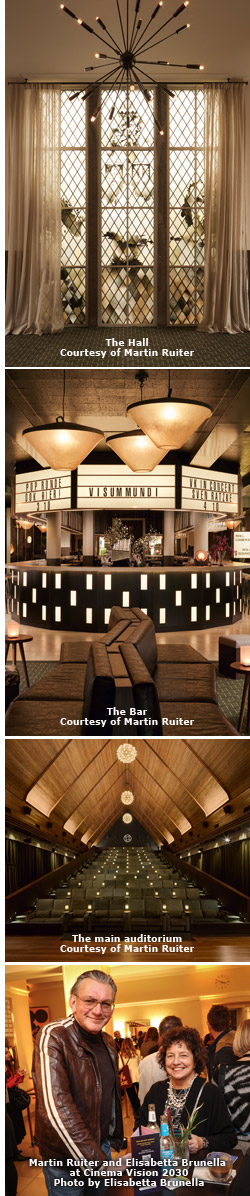 In Wageningen, a historic town southeast of Amsterdam, a former university auditorium was transformed in 2024 into a boutique cinema named Visum Mundi, Latin for "perception of the world." In Wageningen, a historic town southeast of Amsterdam, a former university auditorium was transformed in 2024 into a boutique cinema named Visum Mundi, Latin for "perception of the world."
Strongly supported by Martin Ruiter, the cinema owner who already runs the renowned Heerenstraat Theater in the same city, the new facility aims to be much more than a place to watch films. It aims to be a cultural hub where the cinematic experience converges with the experience of live performance and, as its name suggests, broadens the audience's perspectives, enabling, through diverse narratives, a broader and more nuanced vision of reality.
Ruiter explains: "Visum Mundi was designed to offer viewers an innovative experience. I firmly believe that, sooner or later, the gap between cinema and live theatres and theatre will be bridged. Think of visual music and especially the operas that are already being shown on the big screen. And this is just the beginning: the future will bring many new things. It will take time, maybe a couple of years - or twenty -, but don't forget what I'm telling you!"
Ruiter's philosophy is evident in both Visum Mundi's design and programming. Films take center stage, but they are complemented by a variety of events, including live music, lectures, and festivals, which aim to present images, but above all, ideas and stories that matter. Visitors are invited to see the screen as both a canvas and a stage, where the world life is represented and performed.
The building housing the Visum Mundi has profound historical significance. It was completed in 1935 as a lecture hall for Wageningen University's solemn ceremonies and later hosted key moments of the Second World War. On May 6, 1945, following the German capitulation signed the previous day, the hall served as the location for the technical finalization of the surrender agreements. Today, the site is part of Het Vrijheidskwartier, the Freedom Quarter, a redevelopment initiative that commemorates this past by opening the area up for cultural and educational purposes.
The architectural transformation of what became the Visum Mundi was overseen by London-based design firm Fare Inc., which adopted a measured approach to the renovation, preserving the structure and spirit of the original building. "We couldn't alter the historical integrity of the building," said Annie Harrison, project manager.
It was an ambitious challenge for the London-based firm, which wanted and needed to let the structure's history breathe. The result is welcoming spaces with warm tones that reflect the spirit of Wageningen, the city that has become a symbol of the Netherlands' newfound freedom.
The interiors, featuring military greens, light blues, and neutral shades, Pierre Frey camouflage fabrics, and vintage furnishings, hark back to the building's past, while an artwork commemorating its 1935 origins hints at the planned opening of an exhibition space. Upstairs is the "Great Hall," while the ground floor houses the bar, whose horseshoe-shaped counter and backlit panels evoke a typically cinematic elegance.
Sustainability plays a key role in defining the venue's identity: the seating is made from eco-friendly materials, and the bar serves organic drinks.
The cinema features a Christie 4K laser projector, accompanied by advanced audiovisual systems that support the facility's hybrid mission.
The Alcons audio system includes three CR3bi speakers, two subwoofers, sixteen surround speakers, and dedicated amplifiers. The entire audio infrastructure is monitored by a Q-Sys Core 510i processor, allowing for the flexibility needed to present both film and live content.
Installing this technology within a historic building presented structural and acoustic challenges: as Geert Thierij of CinemaNext Netherlands noted, the project required custom solutions to respect the architecture and meet current technical standards.
Visum Mundi quickly distinguished itself with its ambitious and eclectic programming, which goes beyond traditional film screenings and features a selection of arthouse films, recent European productions, re-releases of heritage films, socially themed documentaries, added contents, family-friendly titles, and others proposed by researchers at Wageningen University, as well as - in collaboration with the nearby Hotel de Wereld - "Cinematic Diner" evenings, combining dinner and a film.
For example, "Anak Indië" (2025) explores the heritage of the Dutch East Indies; "Italian for Beginners" (re-release) and "Swamp Dogg Gets His Pool Painted" (2024) combine documentary, music, and comedy.
These titles reflect the eclectic and socially conscious programming, often based on the screening of documentaries.
Visum Mundi has also introduced an innovative, bespoke experience with its Signature Room.
This 20-seat room, located on the ground floor, functions as a private cinema, where guests can request customized screenings - whether a favorite classic, their own film, or a corporate presentation - thanks to a Christie RGB projector and a QSC sound system that matches the performance offered in the main theatre. Food and beverages can be ordered, as well as staff support, allowing for exclusive events for groups of up to twenty people.
To underscore the cinema's social nature, the Theatre Lounge was designed, a gathering space where guests can relax before or after a screening, or simply enjoy the atmosphere of the building itself.
But the history of Visum Mundi is still evolving: in the future, plans include the creation of two additional screening spaces, seating 60 and 40, respectively, and the launch of the Wageningen Experience, an audiovisual tour of the city's past and present. Visum Mundi thus presents itself not only as a cinema, but as a gateway to the city's heritage, present, and cultural potential.
"The growth of the cinema market isn't about having ever-larger facilities," Ruiter concludes. "Growth will be in boutique cinemas and theatres that offer exceptional technology, seating, food, and beverages, all designed to create an immersive atmosphere. The key to cinema's success is offering an experience you can't have at home. And that's Visum Mundi's identity." |







 as you may recall, in June we presented the "German way" toward cinema sustainability, a goal for which associations of the German cinema exhibitors have joined forces.